Morocco in 7 Days: Marrakech, Fez, and Chefchaouen
A practical 7-day Morocco itinerary through Marrakech, Fez, and Chefchaouen: trains, riads, souk haggling, and real daily costs.
I first went to Morocco expecting a long weekend in Marrakech and ended up rerouting my whole trip. A traveler I met in a riad courtyard told me the north held the two best stops in the country, and she was right.
The week below is the version I would give a friend. Two days in Marrakech, two in Fez, one travel day between them, and a blue finale in Chefchaouen. It moves at a sane pace and it fits the trains and buses as they actually run.
The 7-Day Route
Here is the skeleton before we fill in the details. This order works because the train and bus connections line up this way, and because each city is a gear change from the last.
- Day 1: Arrive in Marrakech, settle into your riad, and spend the evening at Jemaa el-Fnaa square.
- Day 2: Marrakech medina, the souks, Bahia Palace, Ben Youssef Madrasa, and Jardin Majorelle.
- Day 3: Travel day, the ONCF train from Marrakech to Fez (about 7 hours).
- Day 4: Fez medina, the Chouara Tannery, and the great madrasas.
- Day 5: Slow day in Fez, with an optional half-day trip to the Roman ruins of Volubilis.
- Day 6: CTM bus to Chefchaouen, an afternoon in the blue medina.
- Day 7: Chefchaouen morning and sunset at the Spanish Mosque, then depart via Tangier or return to Fez.
Days 1 and 2: Marrakech
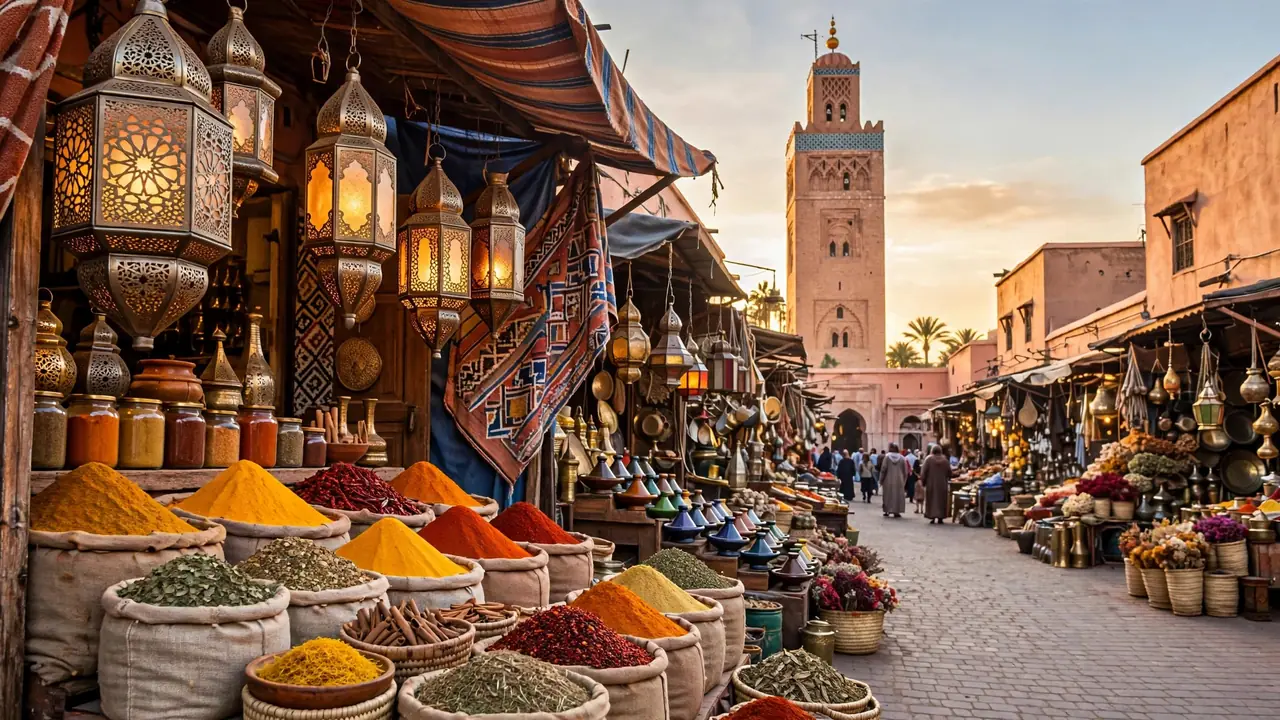
Marrakech hits you immediately. The medina is a maze of souks behind the Koutoubia minaret, mopeds squeeze past donkey carts, and Jemaa el-Fnaa square changes personality three times a day.
On day one, do almost nothing except arrive and go to the square at sunset. The grill stalls fire up around 6 pm and the whole place fills with smoke and drumming. Pick any busy stall, order skewers and harira soup, and expect to pay 60 to 80 dirhams for a full dinner.
Day two is for the medina proper. Start in the souks while they are still waking up: Souk Semmarine for textiles and lanterns, the dyers’ souk for the dye pits, and the metalworkers’ square where the hammering never stops. Go early and the shopkeepers offer tea instead of hard sells.
Midday, visit Bahia Palace (around 70 dirhams) and the Ben Youssef Madrasa (around 50 dirhams). The madrasa’s courtyard, all carved cedar and zellige tile, is the most beautiful single room I saw in Morocco.
Spend the afternoon at Jardin Majorelle, the cobalt-blue villa garden once owned by Yves Saint Laurent. Book tickets online before you go, because the gate line can run over an hour in high season. Entry to the garden is around 165 dirhams, and the small Berber museum inside is worth the add-on.
Eat tangia while you are here. It is Marrakech’s signature dish, beef slow-cooked in ash in a clay urn, and the real stuff comes from the mechoui alley near the square. A portion costs 50 to 70 dirhams and feeds one hungry person easily.
End day two on a rooftop. Places like Nomad and Atay Cafe serve modern Moroccan food above the medina rooftops, and dinner runs 150 to 250 dirhams per person. Book ahead for sunset tables in spring and autumn.
One piece of advice for the whole week: stay in a riad at least once, because it changes how the entire trip feels. These courtyard townhouses are the soul of the Moroccan medina, and I explain why in the section below.
Day 3: The Travel Day to Fez
The train from Marrakech to Fez takes about 7 hours and costs roughly 200 to 300 dirhams in second class. It is a genuinely pleasant ride, past olive groves and wheat fields with the Middle Atlas rising on the horizon. Book through the ONCF site or at the station a day ahead.
Book first class if you want a guaranteed seat; second class is perfectly comfortable but fills up on weekends. Bring snacks and water, because the cafe car is basic.
You will arrive at Fes Ville station, the newer of the two Fez stations. A petit taxi to the medina should cost 15 to 20 dirhams with the meter running. Agree on the meter before you get in, not after.
Days 4 and 5: Fez
Fez is the oldest, the least polished, and in my opinion the best of the three cities. Fes el Bali is the world’s largest car-free urban area, a UNESCO-listed medina of some 9,000 alleys where craftsmen still work the way their grandfathers did.
Go to the Chouara Tannery first thing in the morning. The leather shops around it will hand you mint to hold against the smell and lead you to their terraces, which is exactly the view you have seen in every photo. There is no official entry fee, but buy something small or tip the shopkeeper for the terrace.
After the tannery, walk to the Bou Inania Madrasa and the Al-Attarine Madrasa, two 14th-century schools with stone and tile work that rivals anything in Marrakech. Then pass through Bab Bou Jeloud, the famous Blue Gate, and eat lunch in the food souk. A bowl of harira and a stuffed msemen costs about 25 dirhams.
Fez rewards a second, slower day. The Al-Qarawiyyin mosque houses the world’s oldest continuously operating university, founded in 859, though non-Muslims can only admire it from the doorways. The Jnan Sbil gardens are a quiet escape when the medina gets loud.
If you want one excursion, take the half-day trip to Volubilis, the Roman ruins about an hour west. Shared grand taxis from Fez cost around 150 dirhams per person return.
Food note: Fez makes the best pastilla in Morocco, the sweet-savory pie of shredded pigeon or chicken with almonds and cinnamon. Order it at a traditional restaurant and share one between two. French will get you further than English in Fez, and if you are nervous about the language gap, these tips for traveling without speaking the language work well here.
Days 6 and 7: Chefchaouen
The CTM bus from Fez to Chefchaouen takes about 4 hours and costs around 80 dirhams. There is no train station in Chefchaouen, so the bus is the way in. Sit on the left side for the first views of the blue town in the Rif Mountains.
The blue is practical as much as pretty. Locals will tell you it keeps houses cool and mosquitoes away, and the town repaints the medina every spring. Wander without a map; the old town is small enough to get happily lost in and every alley photographs well.
Plaza Uta el-Hammam is the main square, ringed with cafes that are perfect for mint tea and people-watching. The kasbah museum on the square costs about 60 dirhams and covers the town’s history, from its 1471 founding to the Spanish era. The Grand Mosque’s octagonal minaret is the square’s landmark.
Walk up to the Spanish Mosque for sunset. It is a 30-minute climb east of the medina and the panorama of the blue town in the valley is the single best view of the trip. Bring a jacket; the mountain air cools fast after dark.
On your last morning, visit Ras El Ma at the medina’s edge, where spring water runs through stone channels and locals wash clothes and cool off. Then choose your exit: Tangier is 2 hours north with an international airport, or take the bus back to Fez. Morocco is also one of the countries you can visit without visa stress, with visa-free entry for most Western passports, so the logistics stay simple.
Riad or Hotel
A riad is a traditional townhouse built around a central courtyard, usually tucked deep in the medina. A good one costs 400 to 900 dirhams a night including breakfast, and the experience is half the reason to visit Morocco.
What you get: a fountain courtyard, a rooftop terrace with medina views, and a host who will draw you maps and call you a trustworthy taxi. Breakfast is usually msemen, eggs, olives, and strong coffee served on the roof. What you do not get: street-facing windows, since rooms face inward, and sometimes thin walls.
Hotels in the new town districts, like Gueliz in Marrakech, are cheaper and quieter with proper pools. But you lose the magic of stepping from a silent courtyard straight into the medina at midnight. My split for this route: a riad in Marrakech and Fez, and a small guesthouse in Chefchaouen, where prices are lower across the board.
Haggling Without Being a Jerk
In the souks, the first price is an opening bid, not an insult. Offer 30 to 40 percent of the asking price, meet somewhere in the middle, and keep it friendly. The shopkeeper is reading you as much as the goods, and a smile genuinely gets a better price.
The walk-away is your best tool. If the price will not drop to your number, thank them and leave slowly.
Half the time they call you back before you reach the corner. If they do not, the price was fair or the next shop has the same thing.
Look for shops marked prix fixe when you are tired of the game. And never accept a “free” guided tour from a stranger in the medina; the commission game is real and the “free” part ends at his cousin’s carpet shop. A quick read of how to avoid tourist scams abroad before you go will save you more than any bargaining trick.
What a Week in Morocco Costs
Budget travelers can do this route for 50 to 70 dollars a day. That means budget riad rooms, street food and market lunches, and second-class trains. Mid-range travelers should plan on 100 to 150 dollars a day for nicer riads, sit-down restaurants, and the occasional taxi.
The big fixed costs are few: Jardin Majorelle at around 165 dirhams, the Marrakech to Fez train at 200 to 300, and the Fez to Chefchaouen bus at about 80. Everything else is negotiable, sometimes literally. The dirham trades at roughly 10 to the dollar, which makes mental math easy.
ATMs are everywhere and cards work in most riads and restaurants, but carry cash for the souks and small towns. The dirham is a closed currency, so exchange inside Morocco rather than before you fly. And do not skip the food markets: our guide to food markets around the world explains why market meals are the cheapest and freshest way to eat, and Morocco proves it daily.
FAQs
Is 7 days enough for Morocco?
It is enough for the classic north loop in this itinerary. You will not see the Sahara or the Atlas Mountains properly, so treat this as trip one. If you have 10 days, add a desert night in Merzouga.
Is Morocco safe for first-time visitors?
Yes, with normal big-city awareness. Violent crime against tourists is rare; the main risks are petty scams and aggressive touting in the medinas. Keep valuables out of sight in Jemaa el-Fnaa and Fes el Bali.
What should I wear in Morocco?
Dress modestly out of respect, especially in Fez and smaller towns: cover shoulders and knees. Linen trousers and loose shirts work for the heat. Women may want a scarf for mosques and conservative neighborhoods, though it is not legally required.
Can I drink alcohol in Morocco?
Yes, but it is not a drinking culture. Licensed restaurants, hotel bars, and some rooftops serve beer and wine; expect to pay tourist prices. Drinking on the street is frowned upon and best avoided.
When is the best time to visit Morocco?
March to May and September to November have the best weather across all three cities. Summer in Marrakech regularly tops 40 degrees, while winter nights in Fez and Chefchaouen get genuinely cold. Pack layers for the mountains year-round.
For current entry rules and seasonal events, check Morocco’s official tourism site before you book flights. Then pack light, bring your bargaining smile, and let the medinas do the rest.